Corresponding author.
Author Notes
Copyright and License information




ABSTRACT
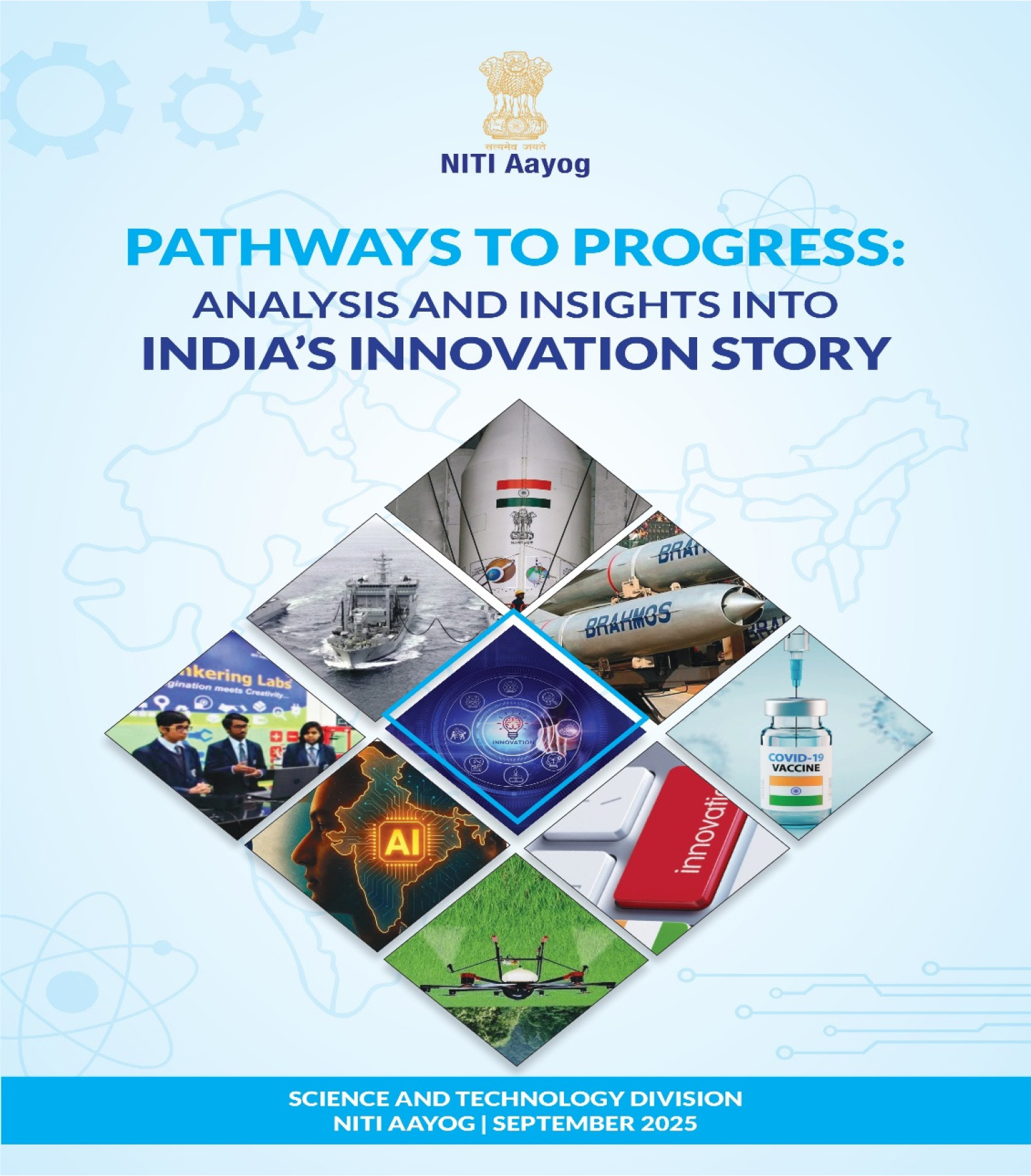
Pathways to Progress: Analysis and Insights into India’s Innovation Story, by V. K. Saraswat, Vivek Kumar Singh, Sujit Bhattacharya, Anurag Kanaujia, Ashok Sonkusare, Thyagaraju B. M., Akanksha Dhamija, Pratibha Chanana, Tusha Agarwal, Simarjot Kaur, Deepak Narang, and Naba Suroor. Science and Technology Division, NITI Aayog, New Delhi, 2025, 166 pages, hardback, ISBN: 978-81-967183-7-4.
International evaluations over the past decades increasingly describe India as an emerging knowledge power rather than a merely “catching-up” (late-developing) science system. Mid-2010s assessments in Nature noted improvements in publication quality and the consolidation of disciplinary strengths, while acknowledging persistent structural limits.[1,2] A recent study places India among the leading contributors to the Nature Index, with notable advances in chemistry, materials research, space science, and climate studies.[3,4] Evidence from Indo-US research partnerships further indicates that India now operates as a near-equal collaborator in strategic fields such as quantum technologies and clean-energy.[5] This scientific progression is reflected in the space sector, where India has moved from an aid-dependent programme to a growing space economy supported by downstream services. It is further reinforced by an expanding private ecosystem shaped by recent commercial and regulatory reforms.[6,7]
India’s expanding scientific profile rests on uneven structural conditions. Econometric analyses show that R&D tax credits have stimulated firm-level patenting and innovation, indicating the efficacy of targeted policy instruments.[8] However, national R&D intensity has remained close to 0.7% of GDP, marked by a disproportionately large public share and sustained calls for increased private investment.[9] The establishment of the Anusandhan National Research Foundation (ANRF) in 2023 aims to reconfigure this funding and governance landscape, though its long-term impact is still uncertain. Within this broader strategic and developmental orientation, the Science and Technology Division of NITI Aayog situates its 2025 report, Pathways to Progress: Analysis and Insights into India’s Innovation Story, framing its assessment of the country’s growing innovation capacity.[10]
The report is built around a clear and coherent structure that allows readers to follow India’s innovation trajectory across conceptual, empirical, and policy dimensions. It opens with reflections from national and international leaders, complemented by an Executive Summary that outlines the report’s central themes. Messages from the Hon. Minister of Education Dharmendra Pradhan emphasise the connection between education, creativity, and national development, while WIPO Director General Daren Tang situates India’s growing intellectual property activity within global innovation trends. These perspectives position innovation as essential to both national progress and international competitiveness, framing the report as a knowledge resource and a strategic roadmap for India’s transition to a knowledge-oriented economy. Within this framing, the report presents a system level view of India’s innovation landscape, drawing on international benchmarks, assessing structural features, and outlining a future policy agenda. It treats innovation as an ecosystem shaped by institutions, governance, policy choices, and societal priorities. Anchored in the vision of Viksit Bharat 2047, it links STI to long term development, making the volume significant for scholars and policymakers.
The Report is organised into seven interlinked chapters, each carrying a distinct analytical purpose. Chapter One introduces innovation as a foundational force in shaping national development and social progress. It traces India’s long-standing commitment to science, technology, and innovation, beginning with early policy efforts to build research capacity and extending to contemporary initiatives that emphasise entrepreneurship, inclusivity, and technological self-reliance. The chapter explains the motivation for undertaking a comprehensive assessment of India’s innovation landscape, noting the importance of integrating diverse institutional actors, strengthening coordination, and aligning scientific and technological activity with broader developmental priorities. It positions the Report as both an analytical exercise and a strategic resource intended to guide future policymaking and ecosystem building.
Chapter Two develops the conceptual foundations of innovation by drawing on Schumpeterian theory, systemic innovation models (national, regional, sectoral and technological), and contemporary frameworks such as the Triple and Quadruple Helix, which emphasise interaction among institutions. It explains how innovation arises from the interplay of knowledge production, resource mobilisation, governance structures, collaborative networks, and societal needs. The chapter traces the shift from linear models to more integrated and iterative understandings of innovation, demonstrating how feedback loops and institutional complementarities shape technological progress. By identifying the essential components of an enabling ecosystem, it provides a coherent analytical base for understanding how diverse actors and capabilities collectively support sustained scientific and technological advancement.
Chapter Three (Indian Innovation Ecosystem) presents a comprehensive overview of India’s innovation architecture at both national and state levels, detailing mission mode programmes, ministerial initiatives, intermediary organisations, and academic support structures. It documents major national efforts such as Atal Innovation Mission, Startup India, Digital India, and sectoral missions in biotechnology, quantum technologies, and semiconductors. The chapter also highlights the growing role of technology incubators, knowledge parks, and grassroots innovation networks. State level policies and industry led initiatives further demonstrate the system’s breadth and dynamism. Together, these elements illustrate how India has expanded its innovation capacity through coordinated interventions across multiple institutional layers. The chapter provides a valuable descriptive inventory; however, the absence of performance metrics on outcomes, funding, patents, or equity constrains its analytical depth and limits its broader policy relevance.
Chapter Four benchmarks India’s performance within global innovation systems using international indices and comparative metrics. It analyses trends reflected in the Global Innovation Index, European and OECD scoreboards, and other global assessments. The chapter documents India’s steady rise in innovation rankings, strong performance in indicators related to human capital, ICT services, entrepreneurship, and creative economy, and the growing presence of Indian innovation clusters in global rankings. It also examines intellectual property trends, publication growth, startup activity, and intangible investment patterns. These comparisons reveal both the expanding scale of India’s innovation outputs and the emerging strategic positioning of the country within global knowledge networks and technology driven economic transitions.
Chapter Five provides a multidimensional characterisation of India’s innovation system using analytical frameworks that examine entrepreneurship, research translation, collaboration, inclusivity, and institutional linkages. It analyses the startup ecosystem’s evolution, the dynamics of university-industry-government interactions, and the role of inclusive and grassroots innovation in broadening societal participation. The framework offers a structured lens through which strengths, patterns, and developmental trajectories can be interpreted objectively. By synthesising indicators on capacity, connectivity, institutional diversity, and knowledge flows, the chapter demonstrates how India’s ecosystem combines advanced technological activity with community-based problem solving, reflecting both maturity and heterogeneity across domains.
Chapter Six outlines key structural and institutional challenges that influence the performance of India’s innovation ecosystem. It identifies issues related to coordination across ministries, uneven funding patterns, limited research-industry linkages, regulatory constraints, skill shortages in frontier technological domains, and infrastructural disparities between metropolitan and hinterland regions. The chapter also notes gaps in intellectual property management, global engagement, and deep technology development. These observations highlight the need for sustained investment, improved institutional alignment, and stronger translational pathways. By mapping challenges across multiple dimensions, the chapter provides a coherent foundation for designing strategic interventions that enhance the efficiency and inclusiveness of national innovation efforts.
The final Chapter proposes a forward-looking roadmap aimed at strengthening India’s innovation trajectory. It emphasises scaling successful models, deepening research capacity, promoting mobility between academia and industry, nurturing deep technology ventures, and enhancing intellectual property frameworks. The chapter advocates building intermediary organisations, strengthening state level innovation capacity, and fostering synergies across institutions to ensure coherent system wide progress. It positions innovation as central to national transformation and underscores the importance of coordinated governance, skilled human capital, and sustained investment for achieving long term scientific and technological leadership.
The report offers an important and timely contribution to understanding India’s evolving innovation landscape. Its strength lies in the breadth of its documentation, the clarity with which it presents institutional developments, and its effort to link national initiatives with wider global trajectories. By bringing together diverse programmes, ecosystem actors, and policy interventions, it provides a consolidated foundation from which future analytical and strategic work can build. Although the report would benefit from deeper empirical evaluation and clearer operational pathways for its recommendations, these limitations do not detract from its overall value. Rather, they indicate areas where subsequent studies may extend the analysis.
Importantly, the report reaffirms that innovation is central to India’s long term developmental ambitions and must be supported through coordinated governance, inclusive participation, and sustained investment in knowledge systems. For policymakers, it offers a coherent structure for understanding the current landscape and identifying future priorities. For academics, it serves as a comprehensive snapshot of India’s innovation architecture and highlights questions worthy of further scholarly inquiry. Ultimately, the report succeeds in positioning innovation as a societal endeavour shaped by institutions, capabilities, and collective aspiration, and it provides a constructive platform for advancing evidence-based STI policy in the years ahead.
References
- Central and South Asia. Nature.. 2014;515(7527):S89-90. [CrossRef]
- Science in India.. Nature.. 2015;521(7551):141 [CrossRef] | [Google Scholar]
- Eisenstein M.. High-impact papers from Indian researchers.. Nature.. 2023;624(7991):S34-6. [CrossRef] | [Google Scholar]
- Leeming J.. India’s year in science.. Nature.. 2023;624(7991):S19 [CrossRef] | [Google Scholar]
- Nature News.. United States and India becoming science partners of equals.. Nature.. 2023 [CrossRef] | [Google Scholar]
- Mani S, Dadhwal VK, Shaijumon CS.. Space economy of India and its economic impact.. Space Policy.. 2025:101692 [CrossRef] | [Google Scholar]
- Porel T, Singh TK.. Evolution of India’s space industry.. New Space.. 2025;13(1):30-7. [CrossRef] | [Google Scholar]
- Ivus O, Jose M, Sharma R.. R&D tax credit and innovation in private Indian firms.. Res Policy.. 2021;50(1):104128 [CrossRef] | [Google Scholar]
- Padma TV.. India must invest more in science.. Nat India.. 2024 [CrossRef] | [Google Scholar]
- Saraswat VK, Singh VK, Bhattacharya S, Kanaujia A, Sonkusare A, Thyagaraju BM, et al. Pathways to progress.. 2025 [CrossRef] | [Google Scholar]